

The FBRF Research Framework
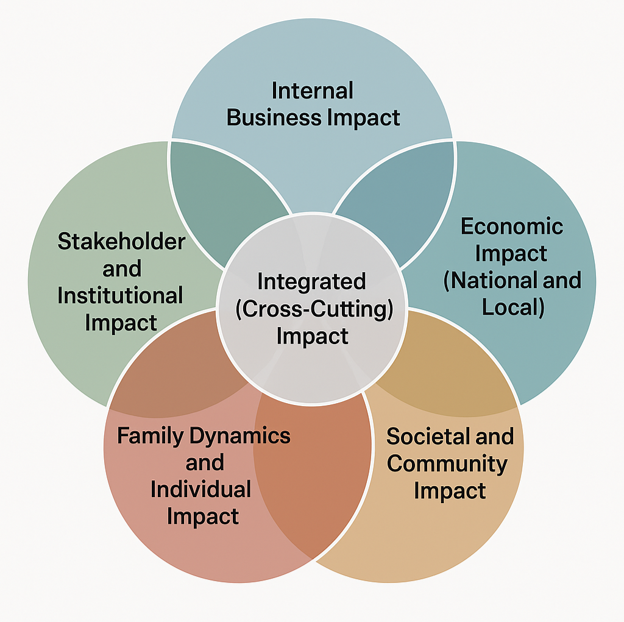
The FBRF Research Framework defines the scope of the Charity’s research activities and captures the broad of range of research, scholarship and practice in the family business space. Family involvement in business can take different forms and can have multiple internal and external effects which often interact. The scope of FBRF research includes family businesses of all sizes from micro family businesses right through to the very largest multigenerational family firms.
Pillar 1 — Internal business effects
Focus: effects on operations; governance; strategy; innovation; employees; performance; productivity.
Pillar 2 — Stakeholder, institutional and policy impact
Focus: includes how family businesses affect external stakeholders (suppliers, customers, non-family managers, government, nonprofits) and how family businesses seek to influence policies and their implementation). Conversely, Pillar 2 also includes how government policies and regulations affect family businesses.
Pillar 3 — Economic effects (economy-wide and local)
Focus: contribution to GVA/GDP, employment, taxation; supply chains; investment; role in regional and local economic development and regeneration.
Pillar 4 — Social and community impact (society-wide and local)
Focus: social and environmental impact; community engagement; philanthropy; sustainability; CSR and ESG.
Pillar 5 — Family dynamics and individual effects
Focus: effects on the owning family; impact on family relationships and individuals; succession; identity; wellbeing; intergenerational transitions; next generation engagement; family governance; role of family business advisors.
Pillar 6 — Integrated/cross-cutting effects
Focus: interconnected effects across domains—legacy; culture; resilience; effects are not independent and involve trade-offs.
An Integrated Approach to Understanding the Effects of Family Ownership
The FBRF Research Framework is based on a comprehensive analysis of research in the family business field on the effects of family ownership. The analysis identified five main areas where family ownership of and involvement in business can have an effect. These different effects can interact and overlap, and this is represented by the overlapping ‘petals’ in the diagram below. The centre of the diagram represents the compounded or interacting effects of family involvement in business. It draws attention to how these effects often overlap and influence one another, creating a complex family business system.
© 2026 Family Business Research Foundation. All Rights Reserved.